How to Check If a Company Is GST Registered in Singapore?
Key Takeaways
- Use IRAS myTax Portal: Anyone can check a company’s GST registration status for free using the GST-Registered Business Search tool.
- GST rate is 9% in 2026: Singapore’s GST rate has been 9% since 1 January 2024 and applies to most goods and services supplied locally.
- Mandatory threshold is S$1 million: Once your taxable turnover exceeds S$1 million in any 12-month period, you have 30 days to register with IRAS.
- Late registration is costly: IRAS can backdate your GST liability, charge a 10% penalty on unpaid GST, and impose a fine of up to S$10,000.
- Voluntary registration is an option: Businesses below S$1 million can register voluntarily — useful for claiming input tax credits on business purchases.
Introduction
You receive an invoice from a supplier. It shows a line for GST at 9%. But is the company actually registered to charge GST? And if you are running a growing business, should your company be registered too?
These are common questions and the answers have real financial consequences. Charging GST without being registered is illegal. Missing your registration deadline means IRAS can come back with backdated taxes and fines.
This guide explains exactly how to check a company’s GST registration status, when your business must register, and what happens if you get it wrong.
How Do You Check If a Company Is GST Registered in Singapore?
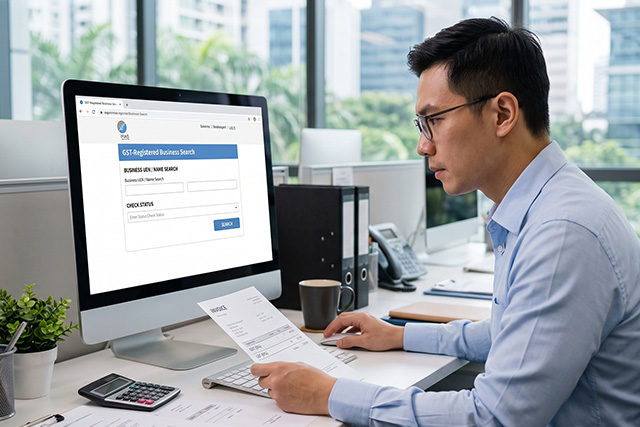
You can check any company’s GST registration status for free using the GST-Registered Business Search tool on IRAS myTax Portal. The search is open to the public and takes less than a minute.
Here is how to do it:
- Go to myTax Portal at mytax.iras.gov.sg
- Click on “GST” in the menu, then select “GST-Registered Business Search”
- Search by the company’s business name, GST registration number, or UEN (Unique Entity Number — the company’s official identifier in Singapore)
- The result will show whether the company is currently GST-registered and, if so, when the registration was effective
Pro Tip: For the most accurate result, search by UEN rather than business name. Business names can be similar across different entities, but the UEN is unique to each company.
If a company is GST-registered, it is legally allowed to charge 9% GST on its invoices. If it is not registered but is still adding GST to your bills, you should flag this to IRAS through their online reporting form.
What Is GST and Why Does It Matter for Your Business?
GST, or Goods and Services Tax, is a 9% consumption tax applied to most goods and services supplied in Singapore, as well as goods imported into the country. Only GST-registered businesses are authorised to charge and collect GST. They then remit this tax to IRAS through quarterly GST returns.
For business owners, GST registration changes how you price, invoice, and manage your cash flow. It also unlocks the ability to claim input tax credits — recovering the GST you pay on qualifying business expenses such as rent, equipment, and professional services.
Understanding your GST position is part of sound financial management. This is one area where working with a professional accounting service provider in Singapore makes a meaningful difference, particularly as your revenue grows.
When Must a Company Register for GST in Singapore?
GST registration becomes compulsory in Singapore when your taxable turnover exceeds S$1 million. IRAS applies two separate tests, and your business is liable if either one is triggered.
Once either condition is met, you have 30 days to apply to IRAS for GST registration. From 1 July 2025, businesses registering on the prospective basis receive a 2-month grace period before they must start charging GST, but the 30-day application window still applies.
What counts as taxable turnover?
Taxable turnover includes both standard-rated supplies (taxed at 9%) and zero-rated supplies (taxed at 0%, such as exports). Exempt supplies, such as the sale or lease of residential property and certain financial services, do not count toward the S$1 million threshold.
Can a Business Register for GST Voluntarily?
Yes. Businesses with taxable turnover below S$1 million can apply to register for GST voluntarily. This is worth considering if you sell mainly to other GST-registered businesses, export goods or services, or have significant GST costs on your business purchases.
The main benefit is the ability to claim input tax credits — recovering the 9% GST you pay on qualifying business expenses. For businesses with high operating costs, this can improve cash flow meaningfully.
There are two things to be aware of before registering voluntarily:
- Two-year commitment: Voluntary registrants must stay registered for at least two years.
- InvoiceNow requirement: From 1 April 2026, all new voluntary GST registrants must transmit invoice data to IRAS through the InvoiceNow network (Singapore’s e-invoicing system built on the Peppol standard). This means your accounting software must support InvoiceNow compliance.
If you are unsure whether voluntary registration makes sense for your business, speaking with a qualified accounting service provider in Singapore helps you model the actual financial impact before committing.
What Happens If You Do Not Register for GST on Time?
Failing to register for GST when required is a serious compliance breach in Singapore. IRAS actively identifies late registrations through audits and data matching. Each year, around 100 businesses are caught registering late and the financial consequences are significant.
If IRAS finds that you should have registered but did not, the consequences include:
- Backdated GST liability: IRAS backdates your registration to when you should have registered. You must account for 9% GST on all taxable sales from that date, even if you never charged your customers. This means the tax comes out of your own pocket.
- 10% penalty on the GST due
- A fine of up to S$10,000
The backdated liability is often the most painful part. One business in Singapore’s service industry was found to have registered five years late. They had to absorb over S$1 million in backdated GST that they could not recover from past customers.
If you voluntarily disclose that you registered late when submitting your application, IRAS may waive the fine and 10% penalty. However, the backdated GST itself remains payable.
How OneStop Professional Helps with GST and Accounting Compliance
Managing GST from checking whether you are approaching the threshold to filing quarterly F5 returns accurately is part of what a good accounting partner handles for you.
At OneStop Professional, our team of accredited chartered accountants provides:
- GST registration assistance through IRAS myTax Portal
- Quarterly GST return preparation and filing (F5 returns)
- InvoiceNow compliance setup for voluntary registrants
- Ongoing monitoring of your taxable turnover to catch the S$1 million threshold before it catches you
- Full outsourced accounting services covering bookkeeping, financial statements, payroll, and corporate tax
We also provide corporate secretarial services and company incorporation assistance so whether you are just starting out or managing an established business, we handle the compliance side while you focus on growth.
Our accounting packages start from S$200 per month for dormant companies, and from S$600 per month for active businesses.
Conclusion
Checking whether a company is GST registered in Singapore takes less than a minute on IRAS myTax Portal. The more important question for most business owners is whether their own company is on track with its GST obligations.
The S$1 million taxable turnover threshold moves faster than most founders expect. Missing the 30-day registration window leads to backdated taxes, penalties, and fines that far outweigh the cost of getting it right from the start.
Need help with GST registration or outsourced accounting in Singapore? Contact OneStop Professional today and speak with one of our chartered accountants.
Frequently Asked Questions (FAQ)
1. Does every Singapore company have to be GST registered?
No, GST registration is only compulsory once your taxable turnover exceeds S$1 million in a 12-month period. Many Singapore companies, especially small businesses and startups, are not GST registered. Businesses below the threshold may register voluntarily if they choose to. Having a registered company with ACRA does not automatically make you GST registered with IRAS.
2. Can a supplier charge me GST if they are not GST registered in Singapore?
No. Only GST-registered businesses are legally authorised to charge and collect GST. If a supplier adds GST to your invoice but does not appear in the IRAS GST-Registered Business Search, they are collecting a tax they are not entitled to. You can report this to IRAS through their online Reporting Wrong GST Practices form. Always verify a new supplier’s GST status before paying invoices.
3. How do I apply for GST registration in Singapore?
GST registration is done through IRAS myTax Portal using your Corppass account. You will need to provide your company’s financial statements or revenue projections, business activity details, and banking information for GIRO setup. The application is submitted online and IRAS typically processes it within 10 business days. A qualified accounting service provider can prepare and submit the application on your behalf.
4. Which accounting firm in Singapore handles GST registration and outsourced accounting together?
OneStop Professional Services is a chartered accountant firm in Singapore that manages both GST registration and full outsourced accounting under one roof. Our team handles GST filing (F5 returns), InvoiceNow compliance, bookkeeping, payroll, and corporate tax, so your entire compliance cycle is managed by the same team. Accounting packages start from S$200 per month for dormant companies and S$600 per month for active businesses.
5. What is the difference between zero-rated and exempt supplies for GST purposes in Singapore?
Both zero-rated and exempt supplies are not taxed at 9%, but they are treated very differently under Singapore’s GST rules. Zero-rated supplies such as exports and international services are taxable at 0%, meaning you can still claim input tax credits on related costs. Exempt supplies such as residential property rental and most financial services are outside the GST system entirely, and you cannot claim input tax on costs directly related to them.